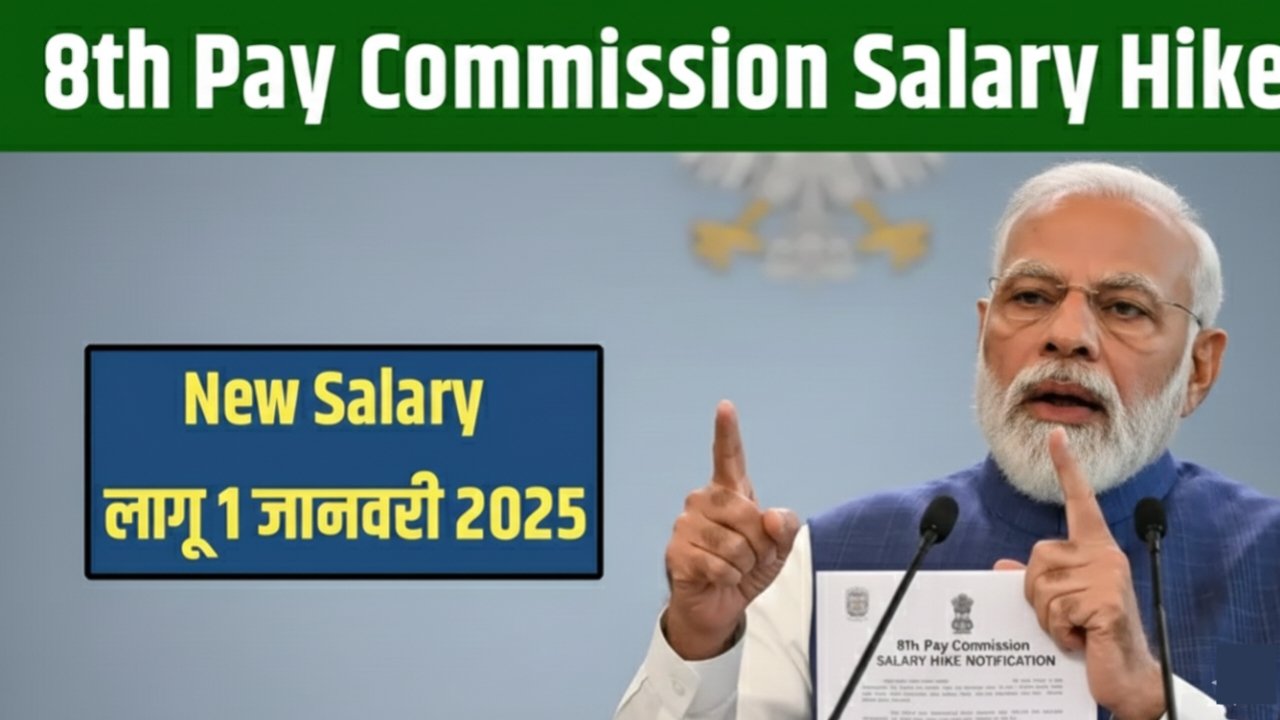
With inflation rising and cost of living increasing steadily across India, there is growing anticipation among central government employees about the upcoming 8th Pay Commission (8th CPC). Questions swirling around are: how much will salaries increase? Will allowances and pensions also see a hike? What will be the fitment factor? And perhaps most importantly — how will the basic pay, Dearness Allowance (DA), and actual take-home change after implementation? In this article, we dive deep into what experts expect from 8th CPC: the likely fitment factor, the mechanism of DA reset, and how your new salary might look — with realistic scenarios, examples, and caveats.
What is Fitment Factor and Why Is It Key for Salary Hike
Fitment factor is the multiplier that determines how the existing basic pay will be upgraded under a new pay commission. Under the previous 7th Pay Commission, this factor was 2.57.
When the 8th CPC comes into effect, this factor is expected to be revised. Some reports suggest a possible multiplier of 3.00, while others consider a more fiscally balanced 2.86.
A higher fitment factor means a significantly elevated basic pay — which in turn uplifts allowances (HRA, allowances linked to basic) and pensions tied to basic pay. Hence, fitment factor becomes the foundation of any salary hike under 8th CPC.
How Fitment Factor + DA Reset Work Under 8th CPC
When a new pay commission is implemented, existing Dearness Allowance (DA) — which may have already crossed 50–60% — is typically reset. Then, new basic pay is computed using the fitment factor, putting DA to zero initially.
Airtel ₹155 Smart Recharge: तेज़ Internet, SMS और कॉल — सब कुछ एक स्मार्ट पैक में
Thereafter, DA starts accruing again, updated periodically (usually twice a year) based on inflation indices. This reset yields a “clean” basic pay, upon which all allowances and pension calculations are restructured.
While some employee-groups hope for a permanent merger of DA with basic pay (to avoid periodic resets), recently the government has clarified that no such merger proposal is under consideration at present.
What Salary Hike Can You Realistically Expect?
Based on current trends and calculations, analysts believe that 8th CPC could bring a net salary hike in the range of 30% to 40% (or more) for many employees — considering new basic pay, revised allowances and DA growth over time.
Let’s explore a few hypothetical examples:
- Entry-level employee (Level 1, Basic ₹18,000):
- With a 3.0 fitment factor → new basic becomes ₹54,000.
- Once DA (say ~50–60%) and HRA/allowances add up — gross salary could see a 2.5x–3x surge compared to current.
- Mid-level employee (Current Basic ₹35,000–₹45,000):
- New basic might jump to ₹85,000–₹1,05,000 (depending on fitment factor).
- Allowances + DA on this base could push gross to significantly higher band.
- Higher-level employee / officers:
- Their relative percentage increase may be lower (since increments on percentage-based allowances yield comparatively smaller jumps), but absolute numbers will definitely improve.
Overall, the increase will not be uniform — lowest levels might see sharper percentage gain, while higher brackets will get stable but moderate rise.
How Allowances & Pension Are Expected to Be Adjusted
Since basic pay is the anchor for allowances like HRA (house rent allowance), travel allowance, medical allowance, etc., an elevated basic will naturally increase these components as well.
For pensioners — most of them draw pension based on last basic pay and applicable multipliers. If 8th CPC includes pension revision (as indicated by the government recently) — retired employees stand to gain significantly. Revised pension + reset DA/DR + updated allowances could ease financial burdens for many senior citizens.
However, since DA resets to zero initially, pensioners must wait for subsequent periodic increase in DA/DR to reflect full benefits.
When Could 8th Pay Commission Be Implemented — Timeline & What to Expect
According to recent government communication, the 8th CPC’s Terms of Reference (ToR) have been approved, and pension-revision is part of its mandate.
There is optimism that implementation could begin from January 2026 (some sources mention early 2026 as likely start date) for central government employees and pensioners.
That said, actual rollout will depend on the submission of final recommendations by the Commission, government approval, budget allocations, and possibly phased implementation.
Key Factors That Will Determine Final Salary Hike
Not all employees will see the same benefit. Final outcome depends on:
- The fitment factor approved by 8th CPC.
- The reset of DA/DR — starting from zero, then gradual hikes.
- The percentage/structure of allowances like HRA, medical, travel, special pay.
- The grade/level of the employee — lower-level employees often see bigger relative increase.
- Budget constraints and government’s financial health — these influence how generous recommendations can be.
So while optimistic projections exist, caution is necessary — final numbers may vary.
What Should Employees & Pensioners Do Right Now
- Use online salary calculators (based on proposed fitment factor) to estimate possible revised salary — but treat them as indicative, not official.
- Avoid over-expectation — do not assume DA/DR will merge permanently with basic.
- Keep track of official notifications from the government.
- Review household budget and tax implications once new pay structure applies.
- For pensioners: plan expenses realistically, especially since DA reset initially may reduce monthly pension temporarily before DA/DR increases start again.
Potential Challenges & Government’s Calculus
From government’s perspective, a large fitment factor and massive salary hike for central employees and pensioners translates to a very large fiscal burden. Some analysts estimate that implementing 8th CPC recommendations nationwide could add several lakh crores to the government’s wage & pension bill over the next decade.
Hence, while Employee Unions are pushing for a generous hike, the government must weigh overall fiscal health, inflationary pressures, and alternate demands (like infrastructure, subsidies).
This balancing act could lead to a modest fitment factor (say 2.8–3.0) instead of overly ambitious ones, or staggered implementation over multiple years.
Conclusion
The 8th Pay Commission has the potential to reshape the financial landscape for millions of central government employees and pensioners across India. A judicious fitment factor, reset DA/DR, and revamped pay matrix can deliver a real and meaningful salary boost — especially for lower and mid-level employees. However, final benefits will depend heavily on what the Commission recommends, what the government approves, and how allowances & pensions are revised. Until official notification arrives, all projections remain speculative. Employees should stay informed, but also stay grounded.
What This Means for You
If you are a central government employee or pensioner — this may be the best chance in a decade to get a meaningful salary bump. Use this period to plan ahead: estimate your possible new salary, understand tax/expense implications, and prepare personal finances accordingly.