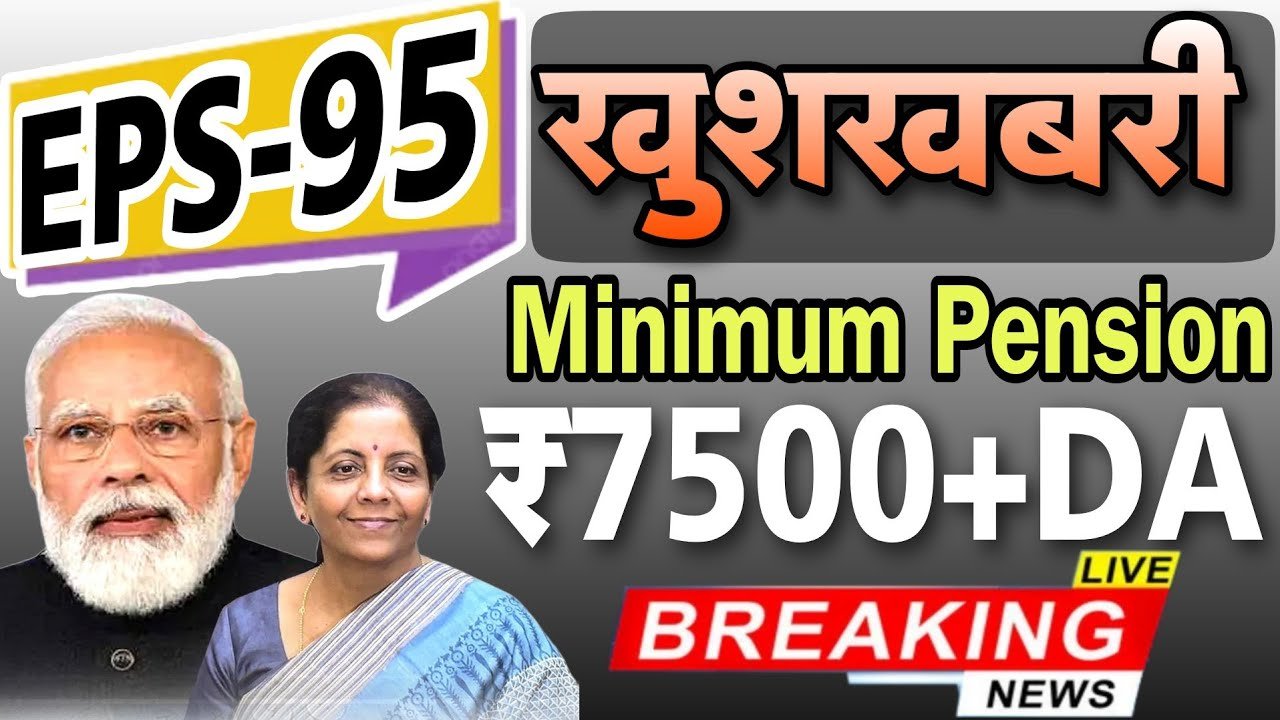
EPS-95 Pension Update 2026: Will Minimum Pension Finally Rise From ₹7,500. For decades, the Employees’ Provident Fund Organisation (EPFO)’s Employees’ Pension Scheme (EPS-95) has served as a social security lifeline for millions of private-sector and organized-sector workers across India. Yet, the minimum pension promised under EPS-95 — a mere ₹7,500 per month — has drawn persistent criticism from pensioners who argue this amount is grossly inadequate in today’s cost-of-living environment. As 2026 begins, renewed calls, parliamentary questions, and media speculation have intensified around a possible revision of this minimum pension. The central question on everyone’s mind: will EPS-95’s minimum pension finally rise from ₹7,500 — and if yes, to what extent?
This article unpacks the latest developments, official statements, pensioners’ demands, and the financial viability of raising the minimum EPS-95 pension. It aims to offer a balanced view of what retirees and subscribers can realistically expect in the coming months.
What is EPS-95 and who are its beneficiaries?
EPS-95 was introduced in 1995 to provide a pension scheme for workers in India’s organized sector. Under the scheme, employers contribute 8.33% of the employee’s wages, and the central government adds a 1.16% contribution — limited to salaries up to ₹15,000 per month. These contributions build a pension corpus, which is used to pay monthly pensions once a subscriber retires, or qualifies under other criteria such as disability or death.
The scheme covers a wide cross-section of workers — from factory or mill employees, private-sector staff, to office workers in small and medium enterprises, and many more. Over the years, EPS-95 has become the backbone of post-retirement security for millions who otherwise had no pension or retirement backup. As of 2025, the scheme reportedly covers over 80 lakh pensioners and ex-employees.
Yet a long-standing concern has been the extremely low minimum pension — ₹1,000 — which many feel is insufficient to meet even basic living expenses.
Why pensioners demand a minimum pension hike — inflation, cost of living and more
The push for an increase in the minimum pension under EPS-95 is rooted in two fundamental realities: soaring cost-of-living and eroding purchasing power. Over the last decade, inflation has pushed the prices of essentials — food, medicines, utilities, housing — to levels where ₹1,000 per month seems largely symbolic rather than helpful. Pensioners argue that this amount does not offer real financial security or dignity.
Moreover, many EPS-95 pensioners are retirees with limited other income. For them, ₹1,000 does nothing to cover even basic monthly expenses. Demand from pensioners’ associations has therefore been consistent: raise the minimum pension to at least ₹7,500 per month, and add dearness allowance (DA) to adjust regularly for inflation.
Besides inflation, pensioners also point to rising healthcare costs, age-related medical needs, and the expense of supporting dependent family members. A pension of ₹1,000 offers negligible assistance in such situations. This growing disparity between pension payouts and living costs fuels pressure on the government to reconsider the minimum pension slab under EPS-95.
What has the government said recently — no hike for now
The latest parliamentary session (Winter Session 2025) saw renewed demands from pensioners for an increase in the minimum EPS-95 pension. MPs raised questions about whether the government is ready to raise the amount from ₹1,000 to ₹7,500 and whether pensioners would get DA. However, the official response from the government was disappointing for many. The government clarified that there is currently no proposal to raise the minimum pension under EPS-95. The primary reason cited: the pension fund is facing an actuarial deficit, meaning payouts currently exceed the sustainable level of returns and contributions.
The same statement reaffirmed that the minimum pension will remain ₹1,000 per month for now, and no DA or other enhancements are being considered.
This government stance has dashed hopes among many pensioners and triggered disappointment and anger, as many had pinned hopes on this Winter Session to deliver a meaningful relief.
Pensioners’ demands and their arguments — why ₹7,500?
Pensioners and their representative associations argue that ₹7,500 per month should be the new benchmark — not as a windfall, but as a basic living pension adjusted to 2025–26 economic realities. Their arguments rest on a few points:
- Inflation adjustment and cost of living: Many essential goods and services have become several times more expensive since EPS-95’s minimum pension was set. A ₹1,000 pension doesn’t count for real support, especially for essential expenses like medicines, food, electricity, and housing.
- Social security and dignity in retirement: For many retirees, EPFO pension remains their sole or main source of income. A higher pension would enable them to live with dignity instead of depending on family or returning to work.
- Parity and fairness: In other pension or social security schemes (for government pensioners or social welfare beneficiaries), pension/facility amounts are often higher. Pensioners under EPS-95 feel left behind.
- Sustainability with contribution history: Many workers contributed to EPS-95 over decades under old rules, expecting some meaningful return after retirement. Pension associations argue that the government should honor that expectation.
Given these issues, pensioners believe ₹7,500 is not generous, but a realistic minimum — one that offers a basic level of financial security.
Is a hike financially viable? The problem of actuarial deficit
The core reason the government cites for not raising the minimum pension is the structural financial weakness of the EPS fund. According to official statements, actuarial valuations have shown that future liabilities (i.e. pensions to be paid) are significantly higher than the inflows and returns the fund can guarantee under current contribution norms.
EPS-95 operates as a “defined contribution–defined benefit” plan: employer and government contributions accumulate to pay future pensions. But with rising life expectancy, increasing number of retirees, and inflation increasing cost of living, payouts have grown drastically while contributions remain fixed or capped. This imbalance creates a deficit that the government fears might grow larger if pension amounts are increased, thereby threatening long-term sustainability.
Hence, while pensioners’ demands are understandable, the government argues that without reform in contributions — or increase in the wage ceiling for contributions — simply raising pension payouts could jeopardize the entire scheme.
What about demand for raising contribution ceiling and structural reform?
Many experts and pensioners propose that if EPS-95 is to survive sustainably while offering reasonable pensions, structural reforms are needed. One main demand is to raise the wage ceiling on which pension contributions are calculated. Presently, contributions are capped for salaries up to ₹15,000 per month — meaning higher paid employees don’t contribute proportionally, and pensions remain modest.
If the ceiling is raised (for instance to ₹25,000 or more), contributions would increase accordingly, thereby enlarging the pension corpus and making higher pensions more feasible. Some parliamentary panels have asked the Labour Ministry to conduct a full third-party evaluation of EPS-95 by end of 2025, and consider increasing the minimum pension.
Such reforms — though long-pending — could pave the way for a realistic and sustainable pension hike, while protecting the fund from future deficits.
What pensioners actually got recently — higher pensions for some, but minimum unchanged
Not all news about EPS-95 has been negative. Over the last few months, EPFO has cleared a large number of applications for higher pension benefits (i.e. those whose retirement pensionable salary was higher or who had eligible service years) and issued revised Pension Payment Orders (PPOs). Many pensioners received increased monthly pensions based on actual contribution history.
However, for those who were getting the minimum pension, nothing changed. The government continues to maintain the minimum pension at ₹1,000. Hence, a polarisation emerged — a section of retired employees with higher contribution history got what they deserved, but the most economically vulnerable pensioners (on minimum pension) continue to struggle with the same old amount that doesn’t match contemporary realities.
This partial action has brought some relief to a limited group, but for majority minimum-pensioners, hopes remain unfulfilled.
How realistic is a possible hike in 2026? Factors that matter
If the government considers revising EPS-95 pensions in 2026, a few key factors will influence any decision:
- Actuarial health of the fund: The fund must be properly valued, and deficit gaps addressed before any major increase. Without fixing structural issues — for instance by revising contribution norms — raising pension payouts may only deepen fund stress.
- Wage-ceiling revision: Unless the ₹15,000 salary ceiling is raised (as demand suggests), contributions will continue to be limited, limiting ability to pay large pensions.
- Political pressure and public demand: As more retirees speak up and media highlights the issue (especially ahead of elections or major social welfare budgets), there may be political interest in granting relief.
- Budgetary support from government: Given the fund deficit, the central government may need to allocate additional budget support — which depends on fiscal health and priorities.
- Equity and fairness across pensioners: Any hike should be equitable — not favoring only higher contributors, but ensuring minimum pensioners also get meaningful benefit.
Thus, while a pension hike is technically possible, its feasibility depends on multiple interlinked reforms — not just a headline raise.
What retirees and subscribers should do now — stay informed, check records, update details
If you or your family receives EPS-95 pension, here are a few practical steps to stay prepared for future developments:
- Keep your EPFO / UAN details updated — ensure Aadhaar-bank linking, KYC, nomination details are correct. This helps in receiving arrears or revised pension smoothly.
- Monitor announcements — follow official EPFO website or trusted financial news portals for updates; don’t rely on rumours or social-media messages.
- Raise grievance or enquiry if pension amounts seem incorrect; sometimes pension-related errors or incomplete contributions lead to lower payouts.
- If still working — check your contribution history and whether your basic wage falls under EPS eligibility; some who switched jobs may have lost pension eligibility unknowingly.
- Participate in pensioners’ forums or associations, so that collective demand for reform remains strong and visible.
Staying informed and vigilant is essential, especially since decisions on EPS-95 will influence lives of millions of retirees across the country.
Conclusion
The EPS-95 pension scheme remains one of India’s largest organized-sector social security programs. Yet, the stark contrast between the ₹1,000 minimum pension and the demands for a realistic pension of ₹7,500 (or more) underscores the urgent need for reform. As of December 2025, government statements indicate no plan to raise the minimum pension, citing fund deficit and sustainability issues. However, growing pressure from pensioners, parliamentary panels, and public debate suggests the issue is far from settled.
For 2026, a meaningful revision — especially a hike in minimum pension — remains uncertain but not impossible. What matters is that EPS-95 undergoes structural reform: raising contribution ceilings, evaluating fund sustainability, and balancing payouts with financial viability. Without such reform, any increase risks undermining the scheme’s future.
For now, pensioners and subscribers should stay alert, check their records, and hope that the government will prioritise social security before fiscal constraints.